

One advantage of getting older is not wisdom by default, but enough repetitions to recognize patterns.
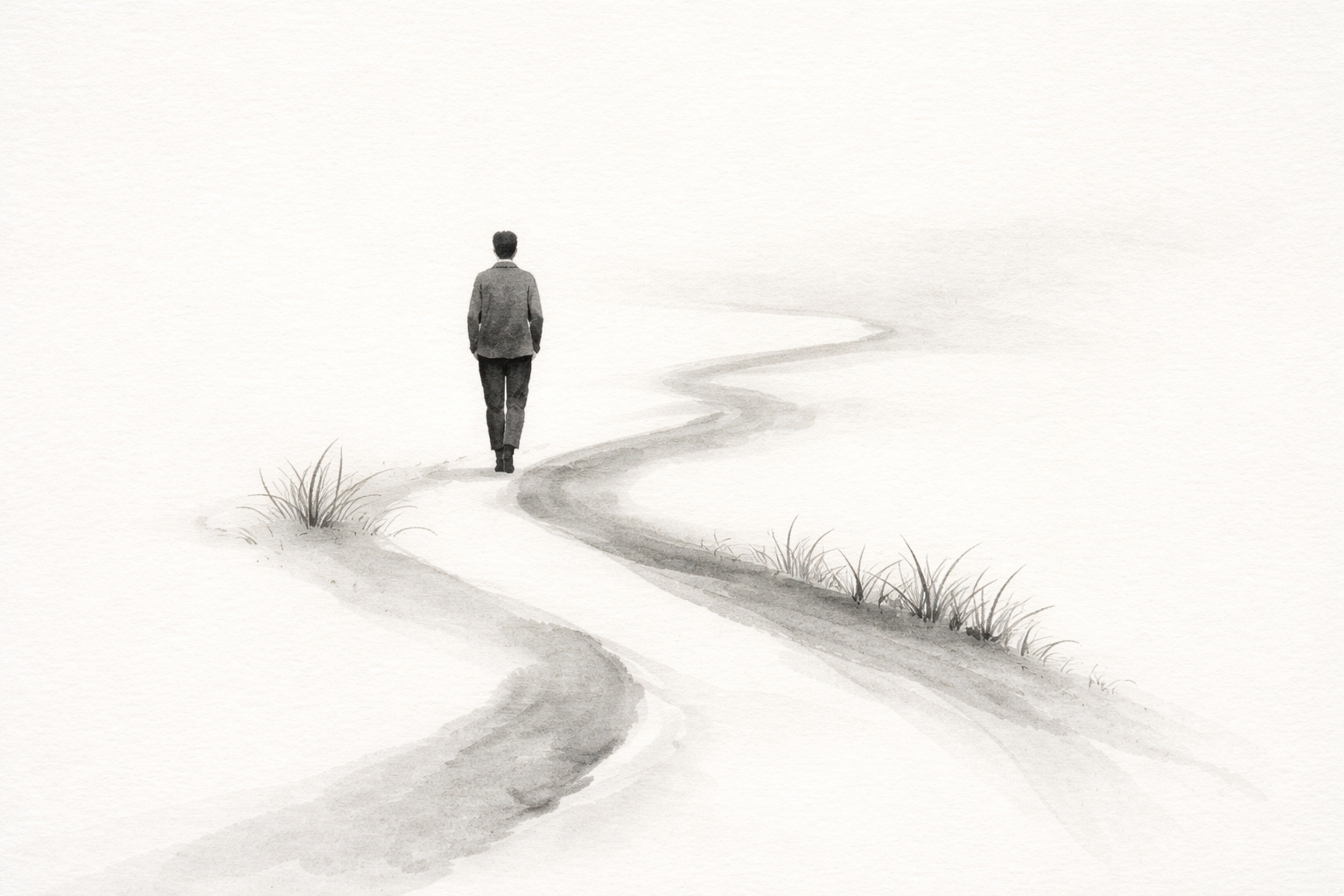
I’m almost 45 now.
That’s how long it took me to clearly see mine. My pattern looks like this:
I start something calmly, with focus.
I get excited, in the flow.
I add more. More intensity, more volume, more scope.
I overreach.
I break down and have to stop.
I start again, convinced this time I’ll do it better.
I see this in training. I see this in work. I see this in other people and in deeply ingrained in our society.
Same loop. Different domains. For a long time, I treated this as a discipline problem, a planning problem, or a motivation problem. It’s none of those. It’s a regulation problem.
Through reading and observation, it became clear that dopamine plays a central role here. Dopamine is often described as the “reward neurotransmitter,” but that’s misleading. It doesn’t reward success, it rewards anticipation. Dopamine spikes when something works, when I get excited and think a little more and it might work even better. That’s the danger zone. When progress appears, dopamine says:
Use it. Expand. Don’t waste this momentum.
That voice sounds rational. It feels responsible. It feels good.
But it’s exactly where the overreach begins.
The obvious response is to build systems: routines, rules, practices that keep me calm and focused. And that does help, to a point.
But here’s the tricky part I did not understand for years:
Even good systems can become dopaminergic. In hindsight I had it when I learned tai chi. I saw this recently again with my standing meditation practice. It worked. I felt grounded and regulated. So I did more. Longer sessions. Several times a day. Then I added more workouts. More work projects. New ideas. A new product. A new company.
It felt amazing, till it did not feel good anymore.
Overreach
Suddenly I couldn’t stay with my standing practice anymore. After three to five minutes I was bored, restless, craving stimulation. The practice that had grounded me no longer held my attention. Nothing was “wrong.”
I had simply tipped the system into dopamine hunger again. Standing meditation requires low stimulation. Sensitivity or better listineng to your inner workings. But when I crave noise, when I have this inner tension, when I'm overstimulation thats impossible.
Calm is fragile
The Christmas break slowed me down. Not because I planned it well, but because my world slowed down and my body demanded to use it. The reduced outside stimulus helped. That pause lowered the inner noise again.
Now I’m restarting, but with one more layer of understanding. A working rule (for now):
Stay with boring, stay with simple.
Don’t add more when you feel like it. If something works, hold it steady.Wait days before adding volume, intensity, or scope.
Calm is not a green light. Calm is the condition I’m trying to protect.
The overstimulated, adrenaline-driven “high performance” mode works shortterm for me but when I have to pay the price. I crash. I’ve run that experiment often enough. This is inevitable, I can only regulate the amplitude.
Now I understand the (Tai chi) saying that yin is invite, yang finite. You can always relaxe and recover more, better and faster. But doing is limited.
This time, the experiment is different.
Not pushing harder.
Not optimizing faster.
Not riding momentum.
Just staying in the relaxed/calm state long enough to see what actually grows there.
Another start. Another chance to learn something real about myself. And maybe to stay with it. To read the signs and react with skill. To regulate the amplitude.
Wow, you put words to something I’ve been feeling but couldn’t quite articulate. It’s wild how we can go on autopilot for so long, ignoring all the little warning lights, and then suddenly everything grinds to a halt, and we’re forced to take a hard look at what’s really going on. The way you described the difference between discipline and regulation—it honestly stopped me in my tracks. I’ve never thought about it that way, and it makes so much sense.
Last year, about this time, Burnout hit me hard and made me realize how much I’d been biting off more than I could chew. We’re always told that energy and enthusiasm are signs to push even harder, but as you said, it’s actually the quiet and calm that need our attention—and our protection.
Since then, I find myself settling into a quieter kind of confidence. Not the loud, ambitious kind I thought I needed in my thirties, but something softer and steadier. Your line about “staying with boring, staying with simple”—that really lands. It’s not flashy, but it feels right. The world’s always shouting for more, but I’m finally okay with less.
Thanks for the reminder that doing isn’t everything. Staying grounded, allowing for quiet—that’s the real work, isn’t it? Here’s to both of us (and anyone else who needs it) dialing down the noise and seeing what actually grows when we give ourselves a little breathing room.
I wish you a happy Sunday, Simon!